
Optical Tower
1. General concept
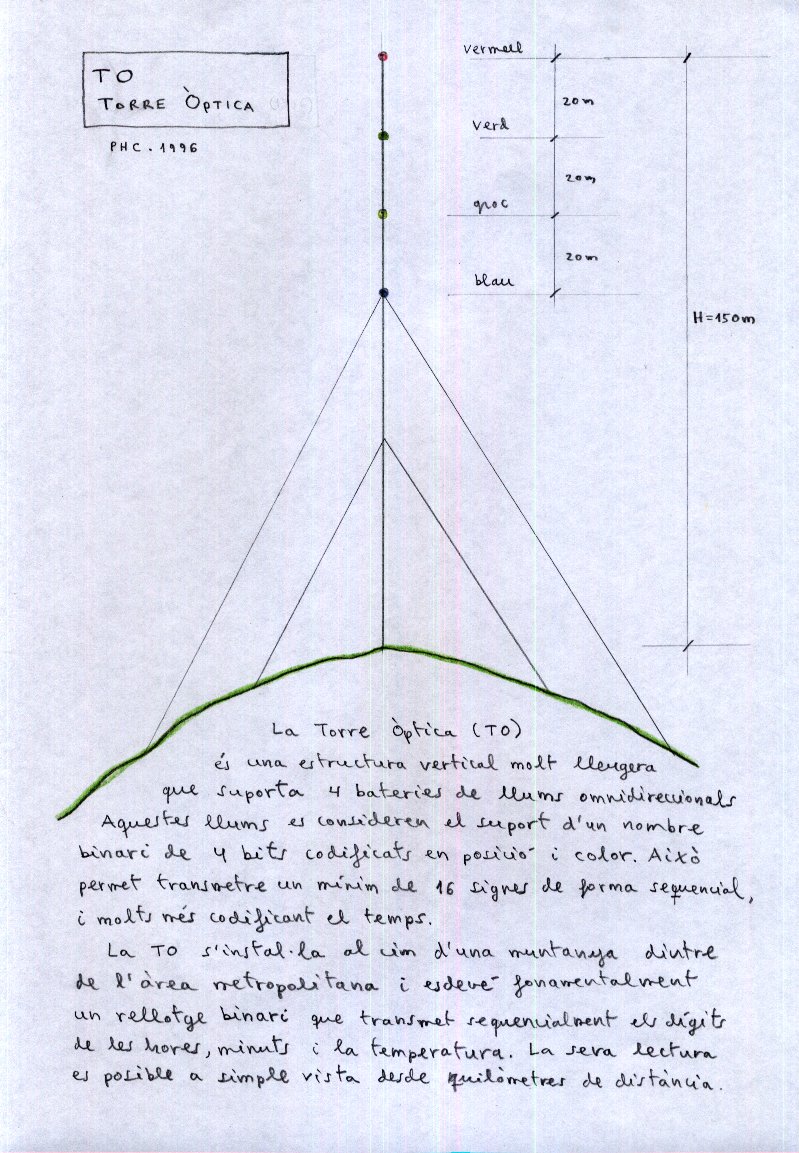
The Optical Tower is a communications tower which, besides transmitting radio signals, is equipped with luminaires that encode a binary number vertically. This binary number will be used mainly as a clock to transmit the time, temperature, or other special signals. In addition, it will be a landmark in the city.
If we consider a 4‑bit Optical Tower, we can encode up to 2^4 natural numbers (16 different symbols, from 0000 to 1111). To simplify its positional reading, the light points will be colour‑coded. For example, the top one in red with binary weight 1, the next one below in green with weight 2, the next below in yellow with weight 4, and the bottom one in blue with weight 8. The large separation between light points allows a great angular resolution of the binary number (far better than conventional tower clocks or digital clocks), and it can be read with the naked eye from kilometres away. To transmit the time and temperature, we only need to send the digits sequentially (one after another) and some coded flashes (1111) to separate hours from minutes and from temperature. Reading the optical tower does not require any electronic device, and it can be deciphered directly without any calculation. One only needs to memorise the code or colours of the 16 natural numbers from 0 to 15, and the complementary signs (flashes) that are established. The principle is the same as explained in the 1986 Binary Digital Clock project.
The main motivation of the Optical Tower was to use a vertical structure or tower to transmit optical signals over long distances, understandable by humans without the need for decoders or additional technology. To demonstrate that binary numbers are very useful for transmitting signs with high angular resolution. What other public clock can be read with the naked eye from 30 km away?
Transmission example. The transmission speed can be 1‑second signs separated by 0.5 seconds of no signal:
1111 A 0.2‑second flash > "Means the time is being transmitted"
0010 > "2"
0011 > "3" That is, it is 23 hours.
1111
1111 Two 0.2‑second flashes separated by 0.2 seconds > "Means minutes are being transmitted"
0100 > "4"
1001 > "9" i.e., 49 minutes
1111
1111
1111 Three 0.2‑second flashes separated by 0.2 seconds > "Means temperature is being transmitted"
0001 > "1"
1000 > "8" i.e., 18 degrees Celsius
Of course, it is possible to transmit other signals, and the combination of flashes and sequences allows many variations. Specific signals can be sent for danger warnings or celebrations. It is an optical bell tower. It would be possible to transmit letters and texts at medium speed, but then electronic decoders would be needed. I also thought of making the tower work with daylight, creating flashes with mirrors reflecting sunlight. Or with LEDs powered by photovoltaic panels covering part of the tower’s surface.
2. Optical Tower Barcelona 2004
In 1998 I designed a 350 m high Optical Tower with 4 omnidirectional luminaires spaced 68 m vertically. The structure was planned to be installed east of the Tibidabo summit in Barcelona, balancing (and surpassing in height) the existing 1992 communications tower. It was the "Barcelona 2004" Tower. Obviously, the project was not built. The reading of the signals would be possible with the naked eye throughout the entire Barcelona metropolitan area, as well as the Maresme, Vallès and Baix Llobregat counties.
3. Variants
The Optical Tower is a minimalist concept. An even more minimalist and much cheaper variant would be to present a binary number as an optical signal transmitter by placing the luminaires horizontally, on small 5‑10 m supports similar to street lighting. If the binary number is placed horizontally, only omnidirectionality is lost, but a good angular resolution can be maintained, though reduced according to the viewing angle.
4. The Joukovsky Tower
A version of a 270 m high Optical Tower, the Joukovsky Tower.