Gravity battery
General concept
The concept of a gravity battery is a bit absurd, but theoretically viable. It is about storing energy in a stone (or concrete block). Simply put, it is about lifting a concrete block from inside a well. Energy is stored in the form of potential energy E = m·g·h. The stored energy is directly proportional to the mass of the block and the height gained. The proposed system for lifting the stone is a gear reduction mechanism driven by an electric motor. The electric motor, which does not need to be excessively powerful, will be powered by photovoltaic panels or wind turbines, or both at the same time. When the sun shines or the wind blows, electricity is generated, making the electric motor spin at high speed and driving the reduction gears; on its slowest shaft a winch will slowly lift the stone, storing energy as potential energy. When we need energy, using the same mechanism, the stone is allowed to slowly descend to the bottom of the well, and as it falls it will make the motor shaft (dynamo) spin at high speed, generating direct current available for consumption. Optionally, inverters can be added to convert DC to AC.
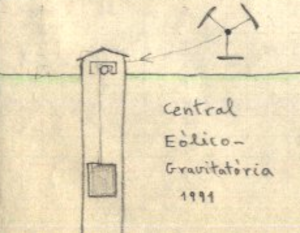
Naturally, this system was invented many, many years ago. And its most practical implementation is lifting water instead of weights (reversible hydroelectric plants). Nevertheless, a well‑dimensioned mass system, if necessary with two or more parallel wells, provides a solution that could be practical for a single household or a small community. Water is always more difficult to handle due to the need for tightness. Stones, on the other hand, are inert and highly durable. Only oversized, well‑maintained mechanisms are needed, along with an automatic electronic control system.
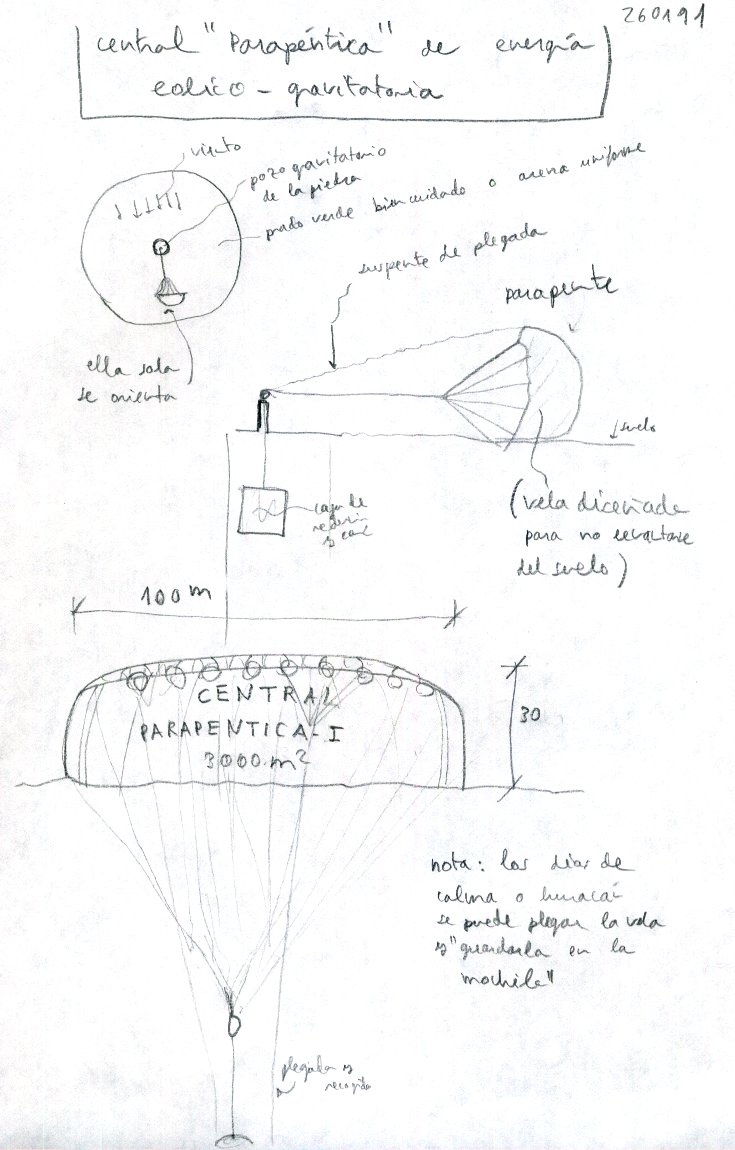
An even crazier version would be the "paragliding wind power plant". It is a system I imagine in a circular grass field. In the centre of the circle there is a well with the gravity battery. In this case, the lifting winch would be driven by a paraglider that could be configured to pull in a horizontal position. Upon reaching the perimeter of the field, control lines would collapse the paraglider along the leading edge and drag it back to the starting position while winch rope is wound in, then the process would restart. Possibly we should talk to friends who generate energy with kites, so that the paraglider pulls preferably in the air, without ground contact, to reduce friction.